Fuze: the ultimate financial planning tool
Our client, Fuze, approached us with a request to implement new changes and integrations based on the needs of a potential customer for their wealth management platform.
One of the main challenges was integrating with the customer’s information source while also improving how financial data was visually displayed and grouped, ensuring it was better suited to the operational needs of this large company. To address this, we introduced a microservice architecture, developing the new module as an independent service to enable scalability and resource efficiency.
During our short-term cooperation, we delivered a stable, scalable integration with enhanced functionality, addressed critical edge cases, and ensured the platform was ready to meet the new client’s operational needs.
Screens



Services
Web development
Front-end
Back-end
Consulting
Technologies
React
Azure
Vercel
.NED
C#
Vezgo
WealthOS
Team Composition
1 Front-end developer
1 Back-end developer
1 Delivery Manager
Product description
Fuze is a platform for up-to-date clarity and visibility across all your clients’ finances and investments. It is an all-in-one solution for various account holders, including financial advisors, wealth managers, financial planners, and private banks.
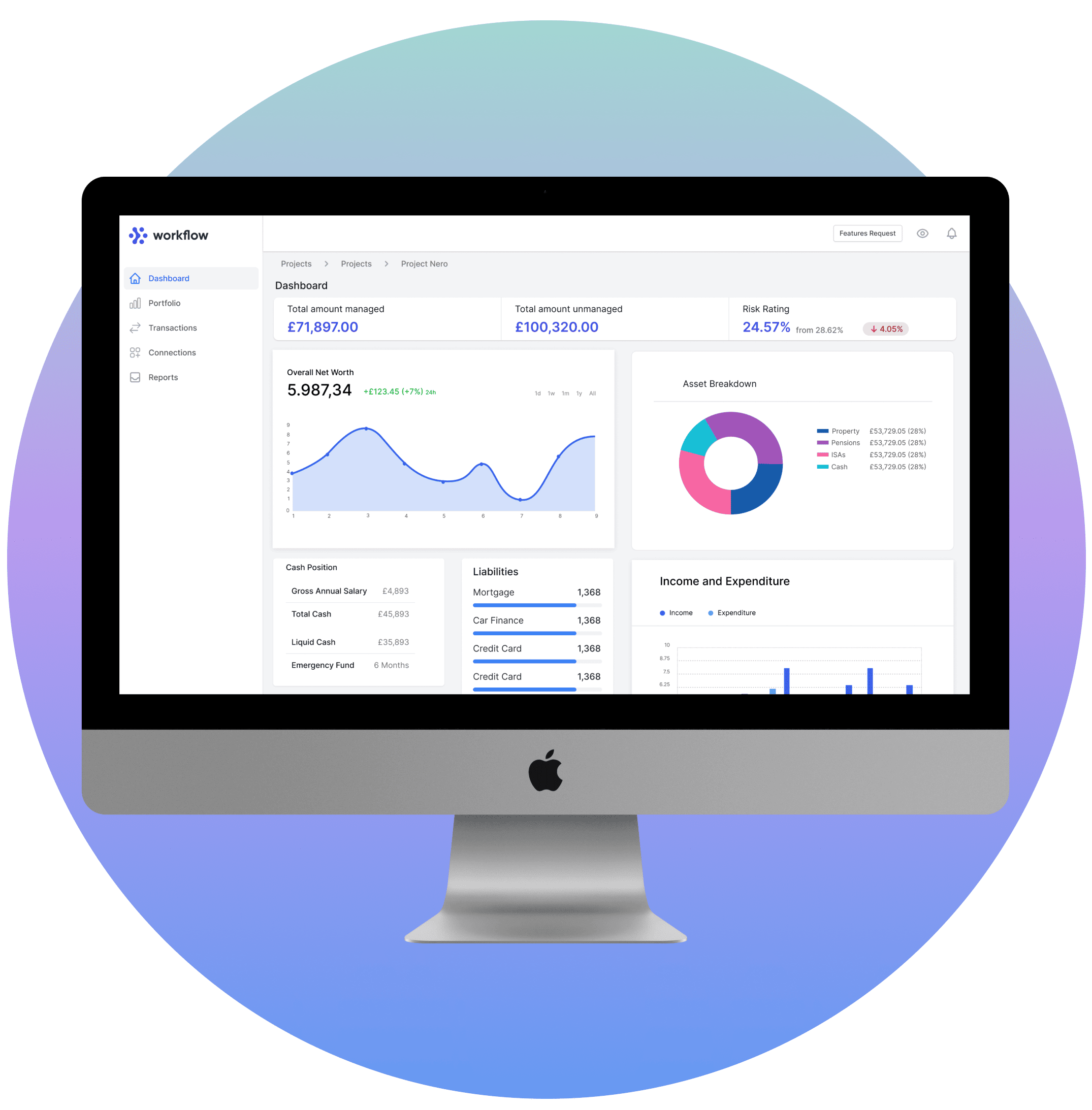
Essentially, it all boils down to this. Fuze aggregates and groups financial data for various organizations. For this purpose, the client supports a large number of integrations with third-party banking services like Open Banking, allowing you to simultaneously work with bank data, cryptocurrency, stocks, Wise, Revolut, etc.
Our client received a request from a potential large customer to integrate with their information source. Fuze also aimed to improve the visual presentation and grouping of financial data to suit the company’s operational needs better and expand the metrics with additional financial indicators.
In order to address Fuze’s need efficiently, our team immediately added back-end and front-end developers to the project and conducted a detailed review of the existing code. This was done to understand how to implement and quickly integrate new functionality, as well as identify potential risks that might arise.
During this stage, we discovered that the front-end part had large pieces of code written using v0 (Vibe coding with AI), and as a result, it was almost unreadable and poorly extensible. Although this approach accelerated initial development, the generated code didn’t have proper structure, clear naming conventions, and scalability principles, making it almost unreadable and hard to maintain.
Our team quickly understood that extending functionality or integrating new modules posed critical risks.
Therefore, we had to rewrite large chunks of the front-end to work with it effectively. On the back-end side, after the review, we decided to develop this module as a standalone microservice that could operate independently from the main application, since it was currently required by only one client.
This made it possible to qualitatively expand its functionality without affecting the main application while making it independent from its core components. During integration with this third-party service, we discovered many edge cases that did not fit the existing functionality’s logic or were poorly thought out. In order to reach the best possible results, we worked on such cases separately, presenting the customer with a ready-made solution for final approval while taking full responsibility for handling these edge cases, analyzing them in detail, and preparing solutions independently.
This decision allowed us to quickly and effectively integrate support for the new system and expand the existing functionality, without drastically affecting existing systems. The final result granted stability and minimal risk of making the overall system unstable.

Fuze: the ultimate financial planning tool
Ready for digital transformation results?
Book your discovery callFeatures
- Comprehensive account connectivity: Thanks to the platform’s support for over 20,000 traditional and non-traditional financial accounts and connections, you can see all of your clients’ financial information in one location.
- Proactive alerts & notifications: Real-time notifications allow for continuous monitoring of consumer conditions and help provide prompt, proactive guidance.
- Income & expense tracking: Learn about your clients’ current revenue and expense tracking, including a thorough spending analysis.
- Advanced reporting tools: Get immediate and easy access to the most recent balance sheet reports and net worth statements.
- Client engagement tracking: Maintain a close eye on yearly client evaluations and provide outstanding service.
- Holistic financial overview: In addition to real-time information on clients’ activities and net worth, you can take advantage of an intuitive platform that summarizes their holdings, assets, and obligations.
- White-label experience: A fully white-labeled platform guarantees your company and clients a consistent brand experience.
- Streamlined client onboarding: Fuze’s onboarding strategy is intended to be effective and stress-free. Focus on growing your business, as the entire process can be finished in a single day.
The results
Provide a stable and scalable integration with the client’s new information source, ensuring seamless data ingestion and compatibility with existing client systems.
Enhanced platform features and usability by rewriting poorly extensible front-end code and building a separate back-end microservice, enabling flexible, standalone functionality within a microservice architecture.
Identified and resolved edge case issues, which provided accelerated delivery, improved data accuracy, and reduced the risk of disruption to current users.